
20-krona banknote
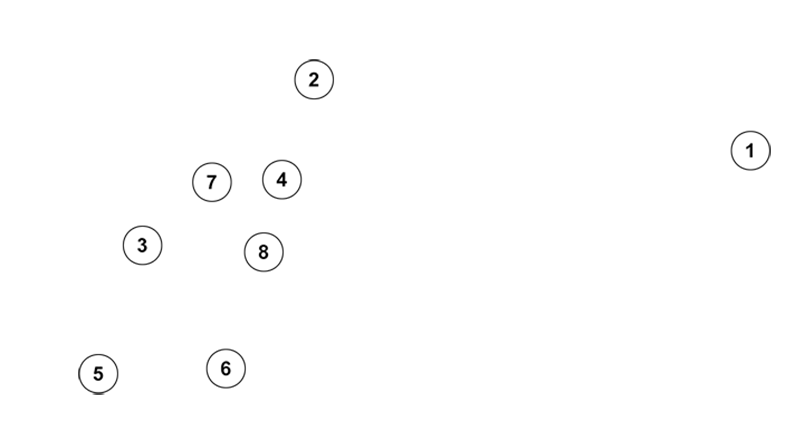
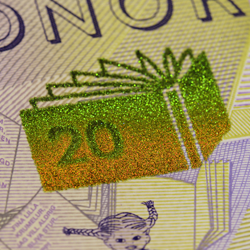
1. Colour-shifting image
Colour-shifting image linked to the person portrayed on the banknote, in this case a book. The banknote's denomination, 20, is also shown in the image. The image and the denomination gradually change colour between gold and green when you tilt the banknote.
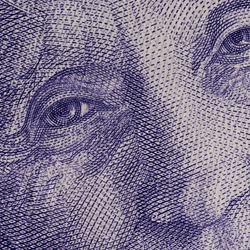
2. Intaglio print
Intaglio print, which makes the paper feel like a banknote and gives it a noticeable raised surface. Run your thumb over it or scrape lightly with a fingernail. Intaglio printing has been used for the portrait, denominations and the text SVERIGESRIKSBANK.
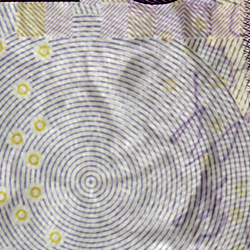
3. Watermark
Watermark with the banknote's denomination and portrait that are visible when you hold the banknote to the light. The denomination appears significantly lighter than the rest of the paper.

4. Security thread
Security thread embedded in the banknote paper. Visible as a dark line when you hold the banknote up to the light.
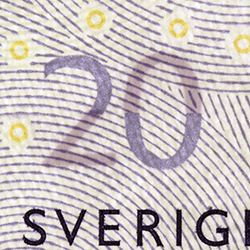
5. See-through picture
A pattern that, together with a matching pattern on the reverse, forms the denomination when you hold the banknote to the light.
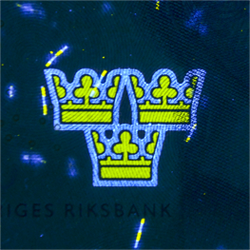
6. UV image
UV image (three crowns) that fluoresces (glows) yellow and blue under ultraviolet light.
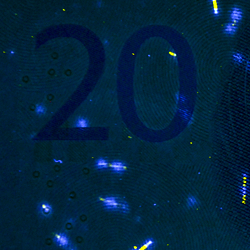
7. UV fibres
UV fibres spread across the entire banknote that fluoresce (glow) yellow and blue under ultraviolet light.
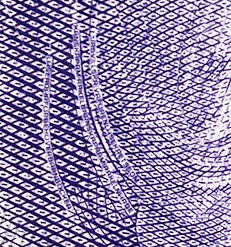
8.1 Micro- and minitexts
Text in Astrid Lindgren’s hair (Astrid Lindgren, Skolbiblioteket 1958:3, in translation: I want to write for readers who can perform miracles. Only children perform miracles when they read. That's why children need books.), written with no spaces or punctuation: JAGVILLSKRIVAFÖRENLÄSEKRETS SOMKANSKAPAMIRAKELBARNSKAPARMIRAKEL NÄRDELÄSERDÄRFÖRBEHÖVERBARNBÖCKER
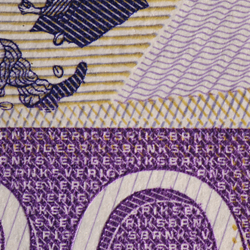
8.2 Micro- and minitexts
Text to the right beside the denomination, repeated several times: SVERIGESRIKSBANK SVERIGESRIKSBANK SVERIGESRIKSBANK
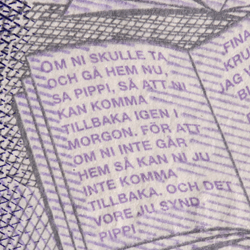
8.3 Micro- and minitexts
Text in the book at the bottom (from Pippi Longstocking, first edition 1945, in translation: Suppose you go home now, said Pippi, so that you can come back tomorrow. Because if you don't go home you can't come back, and that would be a shame. Pippi): OM NI SKULLE TA OCH GÅ HEM NU, SA PIPPI, SÅ ATT NI KAN KOMMA TILLBAKA IGEN I MORGON. FÖR ATT OM NI INTE GÅR HEM SÅ KAN NI JU INTE KOMMA TILLBAKA. OCH DET VORE JU SYND. PIPPI
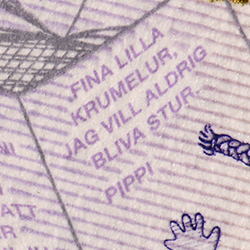
8.4 Micro- and minitexts
Text in the book at the bottom (from Pippi in the South Seas, first edition 1948, in translation: Little squiggle, you are clever, I do not want to grew up ever. Pippi): FINA LILLA KRUMELUR, JAG VILL ALDRIG BLIVA STUR. PIPPI
8.5 Micro- and minitexts
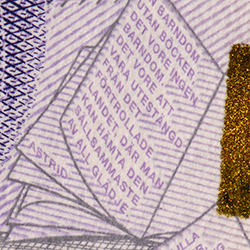
Text in the book at the top (from Om läshunger, essay by Astrid Lindgren in the magazine Vi husmödrar 1956:10, in translation: A childhood without books – that would be no childhood. That would be like being shut out from the enchanted place where you can go and find the rarest kind of joy. Astrid): EN BARNDOM UTAN BÖCKER, DET VORE INGEN BARNDOM. DET VORE ATT VARA UTESTÄNGD FRÅN DET FÖRTROLLADE LANDET, DÄR MAN KAN HÄMTA DEN SÄLLSAMMASTE AV ALL GLÄDJE. ASTRID
8.6 Micro- and minitexts
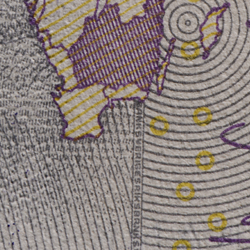
Text on the short edge, repeated several times: SVERIGESRIKSBANK SVERIGESRIKSBANK SVERIGESRIKSBANK
1. Watermark
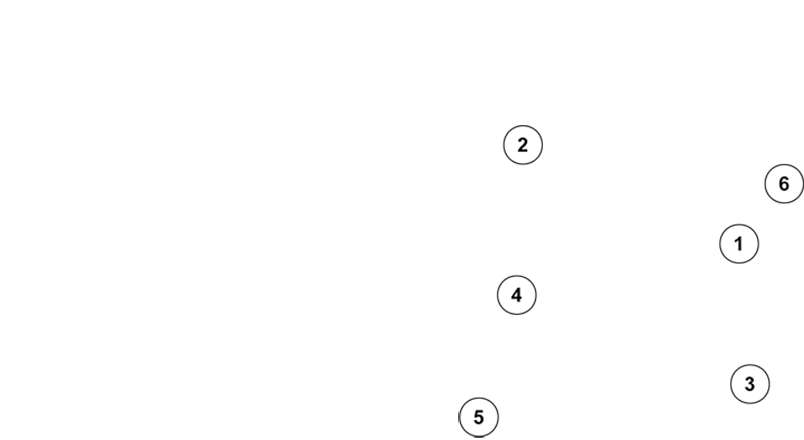
Watermark with the banknote's denomination and portrait that are visible when you hold the banknote to the light. The denomination appears significantly lighter than the rest of the paper.
2. Security thread
Security thread embedded in the banknote paper. Visible as a dark line when you hold the banknote up to the light.
3. See-through picture
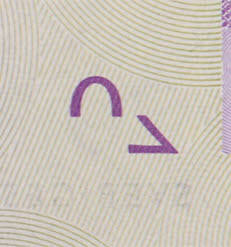
A pattern that, together with a matching pattern on the obverse, forms the denomination when you hold the banknote to the light.
4. UV image
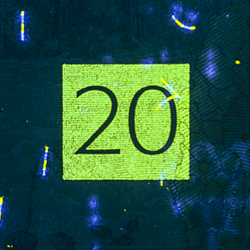
UV image (20) that fluoresces (glows) green under ultraviolet light.
5. UV fibres
UV fibres spread across the entire banknote that fluoresce (glow) yellow and blue under ultraviolet light.
6. Minitexts
Text beside the map, repeated several times: SVERIGESRIKSBANK SVERIGESRIKSBANK SVERIGESRIKSBANK Text on the short edge, repeated several times: SVERIGESRIKSBANK SVERIGESRIKSBANK SVERIGESRIKSBANK
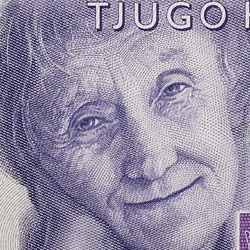
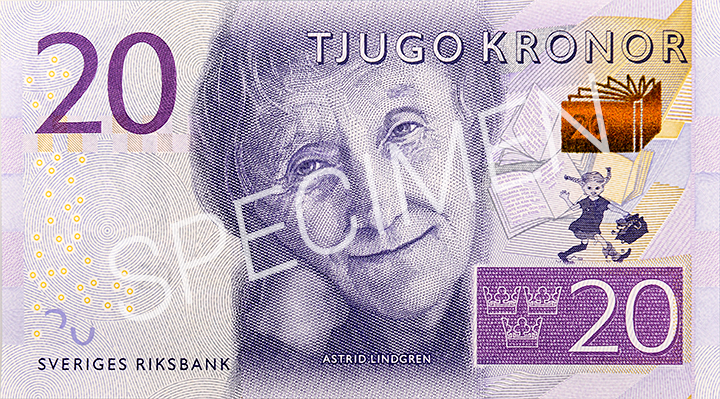
1. Astrid Lindgren
Author Astrid Lindgren (1907–2002) is known world-wide for her children's books about Pippi Longstocking, Emil of Lönneberga and many others. Portrait engraved after a photograph by Jacob Forsell, 1987.
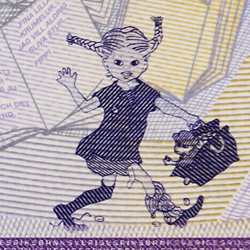
2. Pippi Longstocking
Pippi Longstocking after an illustration by Ingrid Vang Nyman. The first book about Pippi was published in 1945.
3. From the first book about Pippi
Minitext that can be read with the aid of a magnifying glass (from Pippi Longstocking, first edition 1945, in translation: Suppose you go home now, said Pippi, so that you can come back tomorrow. Because if you don't go home you can't come back, and that would be a shame. Pippi): Om ni skulle ta och gå hem nu, sa Pippi, så att ni kan komma tillbaka igen i morgon. För att om ni inte går hem så kan ni ju inte komma tillbaka. Och det vore ju synd. Pippi
3.2 Squigglypills
Minitext that can be read with the aid of a magnifying glass (from Pippi in the South Seas, first edition 1948, in translation: Little squiggle, you are clever, I do not want to grew up ever. Pippi): Fina lilla krumelur, jag vill aldrig bliva stur. Pippi
3.3 The enchanted place
Minitext that can be read with the aid of a magnifying glass (from Om läshunger, essay by Astrid Lindgren in the magazine Vi husmödrar 1956:10, in translation: A childhood without books – that would be no childhood. That would be like being shut out from the enchanted place where you can go and find the rarest kind of joy. Astrid): En barndom utan böcker, det vore ingen barndom. Det vore att vara utestängd från det förtrollade landet, där man kan hämta den sällsammaste av all glädje. Astrid
4. Children perform miracles
Microtext that can be read with the aid of a magnifying glass (Astrid Lindgren, Skolbiblioteket 1958:3, in translation: I want to write for readers who can perform miracles. Only children perform miracles when they read. That's why children need books.): Jag vill skriva för en läsekrets som kan skapa mirakel. Barn skapar mirakel när de läser. Därför behöver barn böcker.
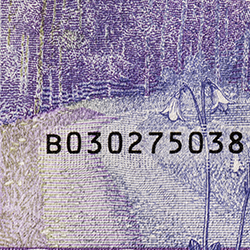
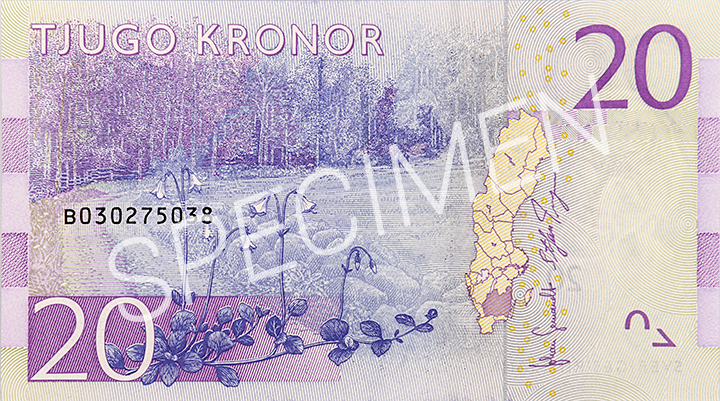
1. Environment motif from Småland
A Småland forest road with stone wall.
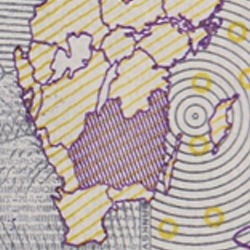
2. Astrid Lindgren’s Småland
Map of Sweden with the province of Småland marked, where Astrid Lindgren grew up on a farm called Näs, near Vimmerby.
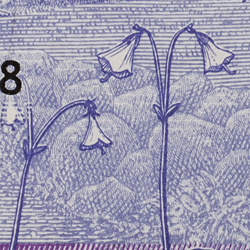
3. Linnaea
The provincial flower of Småland, the Linnaea or twinflower.
Facts
Obverse motif: Children´s writer Astrid Lindgren
Reverse motif: Småland, where Astrid Lindgren grew up
Measures: 120 x 66 millimetres
Thickness: 125 micrometres +/- 10%
Colour: Violet
Will be introduced: 2015
Banknote paper: Manufactured of cotton fibres that are not fluorescent, which is to say they do not emit any light under ultraviolet light (other types of paper may emit a bluish glow).
Banknote numbers: The letters indicate the year in which the banknote was printed. A = 2013, B = 2014 etc. The two first digits indicate where on the printing sheet the banknote was printed. The final seven digits are a serial number.
Valid from 1 October 2015.