
The Riksbank's research agenda
The Riksbank's research agenda contains information on four research areas of importance to the Riksbank's activities. The purpose of the research agenda is to disseminate information about the research conducted at the Riksbank and the areas we consider important for future research and analysis.
The four areas
- New challenges in money, banking and payments
- The monetary transmission mechanism under the microscope
- Structural transitions: labour market, demography and the green economy
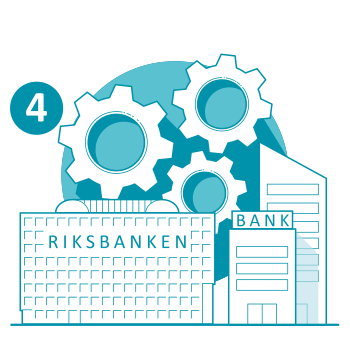
- Monetary, fiscal and financial stability policies in interaction
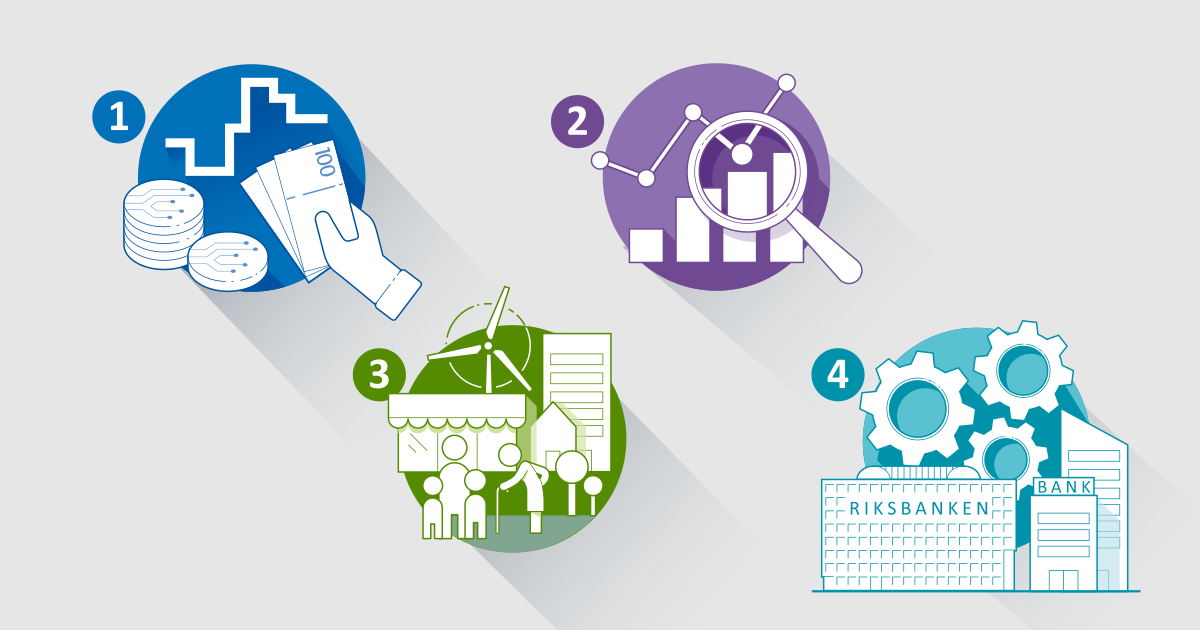
Common to all areas is that the analysis is conducted using modern methods (including artificial intelligence), new data sources (including micro data and large data sets) and with perspectives that are relevant to the Swedish economy (including analysis for an open economy).
New challenges in money, banking and payments
The technological developments that have taken place in recent years are rapidly transforming financial markets. In the area of New challenges in money, banking and payments we explore how changes in the financial system influence the resilience of banks, financial markets and payments.
This area includes research on:

Digital payments, financial fragility and international spillovers.
Risks and opportunities from changes in financial intermediation.
Challenges for the implementation of monetary policy.
Lessons from the history of money, banking and payments in Sweden and beyond.
The monetary transmission mechanism under the microscope
A recurring question in macroeconomics is how the monetary policy transmission mechanism works in practice. Our ability to answer this question has improved dramatically in recent years, thanks to the proliferation of high-quality microdata and more powerful computers and computational methods. Work in the area of The monetary transmission mechanism under the microscope utilises microdata and heterogeneous agent models to investigate the microeconomic foundations of the monetary transmission and their macroeconomic consequences.
This area includes research on:

Monetary transmission with heterogeneous agents.
The heterogeneous effects of monetary policy on households, companies and banks.
Expectation formation and price-setting behaviour.
Structural transitions: labour market, demography and the green economy
The population is ageing, birth rates are falling and technology is developing at a rapid pace; at the same time, a transition to a green economy is taking place. We analyse the macroeconomic and financial implications of these structural shifts in the area of Structural transitions: labour market, demography and the green economy, using both aggregate data and microdata at the household and corporate level.
This area includes research on:

The impact of technological change, automation and globalisation on the labour market.
The impact of demographic and structural changes on savings, consumption, the neutral interest rate, household debt and portfolio allocation, and public finances.
The macroeconomic and financial challenges related to climate change and the transition to a low-carbon economy.
Monetary, fiscal and financial stability policies in interaction
Monetary policy does not operate in a vacuum: its effectiveness and transmission depend on the stance of fiscal policy and the stability of the financial system. Work in the research area Monetary, fiscal and financial stability policies in interaction explores how these three areas of macroeconomic stabilisation interact to shape aggregate demand, risk-taking and long-term credibility. Understanding their common dynamics is crucial to designing robust economic policy frameworks that ensure both short-term stabilisation and long-term fiscal and financial sustainability.
This area includes research on:
Policy coordination and trade-offs.
The interaction between economic policy and financial frictions.
Fiscal constraints, financial vulnerabilities and central bank independence.
Thanks for your feedback!
Your comment could not be sent, please try again later
Questions? Visit our FAQ on kundo.se (opens i new window).